
From now on we Elev8
We're more than just a broker. We're an all-in-one trading ecosystem—everything you need to analyse, trade, and grow is in one place. Ready to elevate your trading?
We're more than just a broker. We're an all-in-one trading ecosystem—everything you need to analyse, trade, and grow is in one place. Ready to elevate your trading?
The Australian Dollar (AUD) holds ground against the US Dollar (USD) on Thursday following the People’s Bank of China (PBoC) interest rate decision. China's central bank announced to leave its Loan Prime Rates (LPRs) unchanged in November. The one-year and five-year LPRs were at 3.00% and 3.50%, respectively. As China and Australia are close trading partners, China’s policy rates can affect the AUD.
The AUD/USD pair rebounded after registering more than 0.5% losses in the previous session as the Australian Dollar received support from improved market sentiment, driven by chip giant Nvidia’s blowout earnings.
The AUD also finds support as expectations grow for a cautious stance from the Reserve Bank of Australia (RBA). Minutes from the RBA’s November meeting indicated the central bank may keep rates unchanged for an extended period if economic data continues to outperform. Steady Q3 wage growth, last week’s strong jobs figures, and persistently high inflation have all strengthened the view that the easing cycle has likely ended.
ASX 30-Day Interbank Cash Rate Futures show that as of November 18, the December 2025 contract traded at 96.41, implying an 8% probability of a rate cut to 3.35% from 3.60% at the upcoming RBA Board meeting.
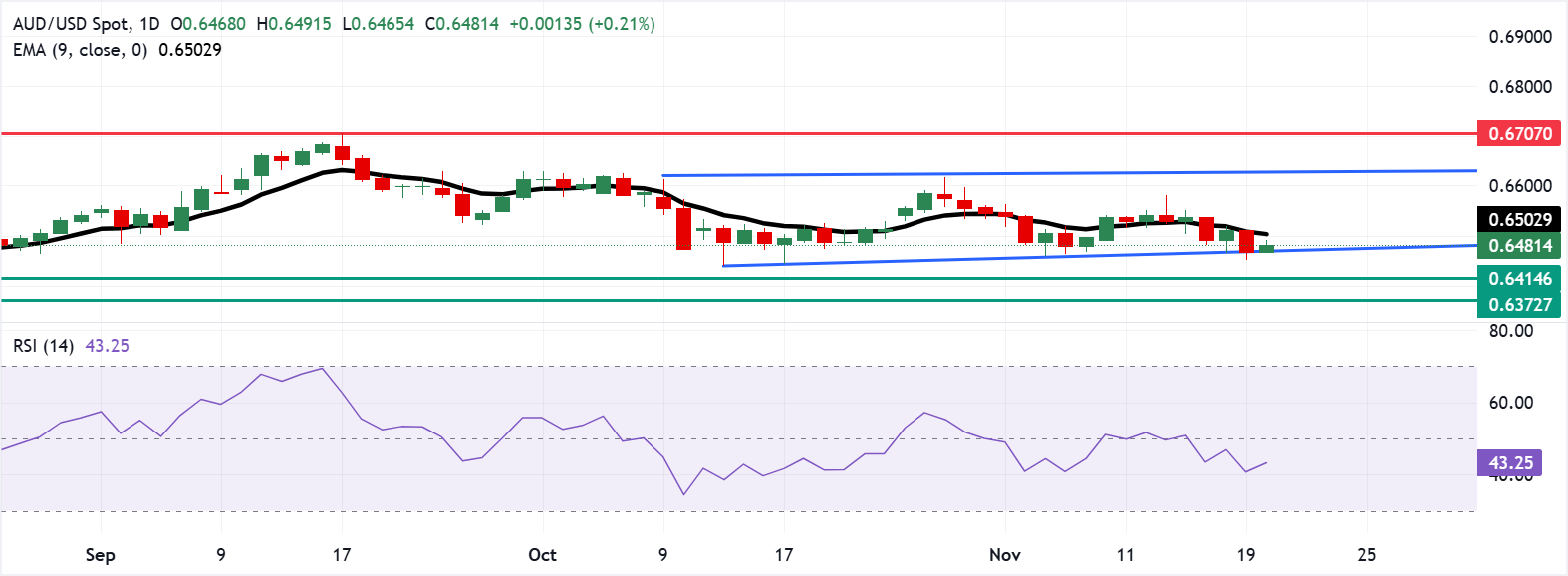
The AUD/USD pair is trading around 0.6480 on Thursday. The daily chart analysis indicates that the pair is moving sideways within a rectangular range, signalling a period of price consolidation. Meanwhile, the price remains below the nine-day Exponential Moving Average (EMA), highlighting that the short-term price momentum is weaker.
On the downside, the AUD/USD pair finds immediate support at the lower boundary of the rectangle around 0.6470, followed by the five-month low of 0.6414, which was recorded on August 21.
The initial barrier lies at the psychological level of 0.6500, followed by the nine-day EMA of 0.6503. A break above this confluence resistance zone would improve the short-term price momentum and lead the pair to reach the rectangle’s upper boundary near 0.6630.
The table below shows the percentage change of Australian Dollar (AUD) against listed major currencies today. Australian Dollar was the strongest against the Japanese Yen.
| USD | EUR | GBP | JPY | CAD | AUD | NZD | CHF | |
|---|---|---|---|---|---|---|---|---|
| USD | -0.03% | -0.03% | 0.03% | -0.05% | -0.23% | -0.19% | -0.03% | |
| EUR | 0.03% | 0.00% | 0.13% | -0.02% | -0.20% | -0.16% | 0.00% | |
| GBP | 0.03% | -0.00% | 0.10% | -0.02% | -0.20% | -0.17% | 0.00% | |
| JPY | -0.03% | -0.13% | -0.10% | -0.12% | -0.30% | -0.30% | -0.11% | |
| CAD | 0.05% | 0.02% | 0.02% | 0.12% | -0.17% | -0.16% | 0.04% | |
| AUD | 0.23% | 0.20% | 0.20% | 0.30% | 0.17% | 0.03% | 0.20% | |
| NZD | 0.19% | 0.16% | 0.17% | 0.30% | 0.16% | -0.03% | 0.17% | |
| CHF | 0.03% | -0.00% | -0.00% | 0.11% | -0.04% | -0.20% | -0.17% |
The heat map shows percentage changes of major currencies against each other. The base currency is picked from the left column, while the quote currency is picked from the top row. For example, if you pick the Australian Dollar from the left column and move along the horizontal line to the US Dollar, the percentage change displayed in the box will represent AUD (base)/USD (quote).
The People’s Bank of China’s (PBoC) Monetary Policy Committee (MPC) holds scheduled meetings on a quarterly basis. However, China’s benchmark interest rate – the loan prime rate (LPR), a pricing reference for bank lending – is fixed every month. If the PBoC forecasts high inflation (hawkish) it raises interest rates, which is bullish for the Renminbi (CNY). Likewise, if the PBoC sees inflation in the Chinese economy falling (dovish) and cuts or keeps interest rates unchanged, it is bearish for CNY. Still, China’s currency doesn’t have a floating exchange rate determined by markets and its value against the US Dollar is fixed mainly by the PBoC on a daily basis.
Read more.Last release: Thu Nov 20, 2025 01:00
Frequency: Irregular
Actual: 3%
Consensus: 3%
Previous: 3%
Source: The People's Bank of China